
Today we are leaving Barcelona and heading out to sea.
This means it is time to discuss one of the oldest pieces of maritime safety advice ever recorded:
If a beautiful disembodied voice begins singing to you from somewhere beyond the railing, do not investigate.
Do not lean over for a better look.
Do not assume Virgin has added surprise nighttime entertainment.
Go inside.
The sirens are singing.
You Already Know the Story
Most of us were introduced to sirens through some version of the story of Odysseus.
The sorceress Circe warns him that his ship will pass the island of the Sirens, whose irresistible song lures sailors to their deaths.
Anyone who hears them will forget home, family, duty, and apparently every useful instinct required to remain alive.
Odysseus wants to hear the song.
Of course he does.
This is a man who has already survived a war, a Cyclops, angry gods, cannibals, enchantresses, shipwrecks, and his own repeated inability to leave well enough alone.
His solution is surprisingly responsible by Odysseus standards.
He orders his crew to plug their ears with beeswax. Then he has them tie him upright to the ship’s mast. No matter how desperately he begs, threatens, or commands them to release him, they must ignore him and tighten the ropes.
The plan works.
As the ship passes the island, the Sirens sing directly to Odysseus.
They promise knowledge. They claim to know what happened at Troy and everything that occurs across the earth.
That is important.
Their song is not merely beautiful.
It offers him exactly what he wants most.
Odysseus struggles against the ropes and begs to be freed. His crew cannot hear him. They bind him tighter and keep rowing.
Once the ship passes beyond the reach of the song, Odysseus returns to himself.
The sailors remove the wax.
Everyone survives.
This remains the gold standard for knowing in advance that you are going to make a terrible decision and arranging responsible supervision.
Homer Forgot to Describe Them
Here is where the story becomes strange.
Homer tells us what the Sirens do.
He tells us where they live.
He tells us about their voices, their knowledge, and the bodies of dead sailors decaying around them.
He does not tell us what they look like.
No feathers.
No wings.
No scales.
No tails.
Not even an official number.
He leaves an enormous visual blank in one of the most famous monster stories ever written.
Artists promptly filled it.
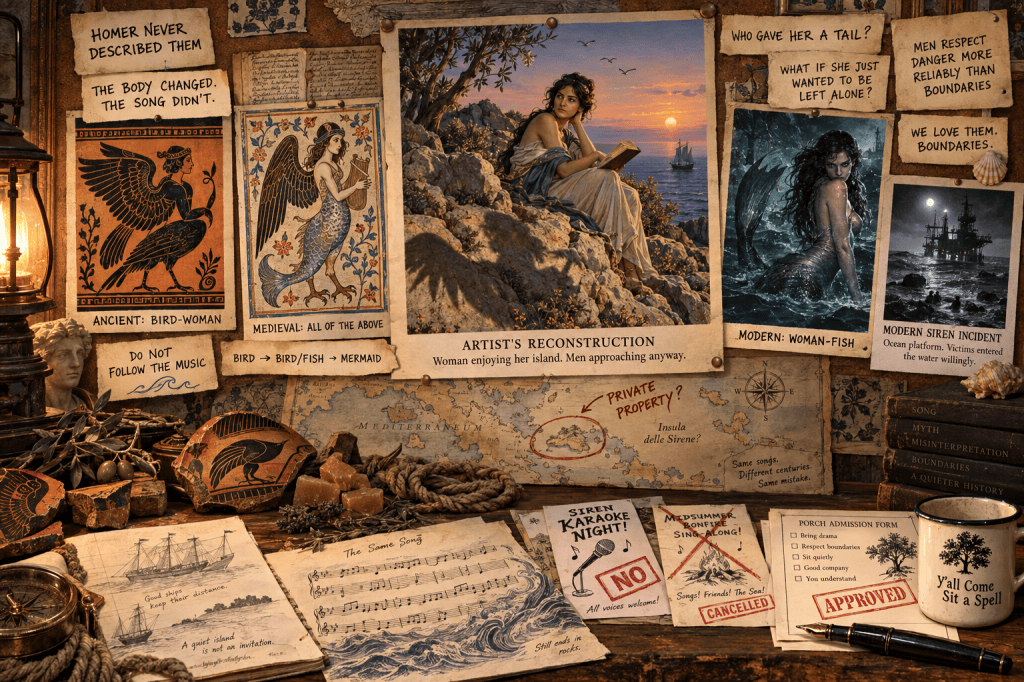
Ancient Greek art usually portrayed sirens as birds with women’s heads. Later versions gave them more of a woman’s upper body while retaining wings, talons, or a bird’s lower half.
They were not glamorous women reclining on rocks and combing waist-length hair.
They were bird-women.
Some traditions connected them to Persephone. They may have been her companions before Hades carried her into the Underworld. In one version, they asked for wings so they could search for her across land and sea. In another, Demeter transformed them as punishment for failing to protect her daughter.
Either way, the wings made sense.
For centuries, if someone told you to picture a siren, you were supposed to imagine something closer to a beautiful harpy than Ariel’s homicidal cousin.
So how in the hell did we get a fish tail?
Medieval People Got Involved
By the early Middle Ages, writers and artists had inherited several overlapping traditions about dangerous women connected to water.
They had the Greek sirens with their fatal song.
They had mermaids and other fish-tailed water beings from European folklore.
They had translations moving between Greek, Latin, and regional languages.
They had bestiaries that mixed natural history, religion, morality, folklore, and animals somebody’s cousin had supposedly seen beyond the edge of the known world.
Precision was not always the main objective.
An early medieval work called the Liber Monstrorum described sirens as sea maidens with the upper bodies of women and scaled fish tails below.
Other manuscripts continued to show bird-like sirens.
Some showed fish-like sirens.
Some apparently looked at the disagreement and gave them wings, clawed feet, and fish tails.
Why choose?
Across medieval Europe, the fish-tailed version became increasingly common. The siren’s irresistible voice and murderous intentions blended with the mermaid’s aquatic body.
Language helped the confusion along. In several European languages, the same word came to be used for both siren and mermaid.
The merger became so complete that modern audiences often assume the ancient Greek sirens always had fish tails.
They did not.
Homer gave us a voice.
Greek artists gave it wings.
Medieval writers gave it a tail.
Popular culture decided the tail photographed better and quietly retired the bird parts.
Sirens and Mermaids Are Not Quite the Same Thing
Traditionally, a mermaid is defined by her body.
She is part woman and part fish.
What she does depends on the culture telling the story.
Mermaids may warn of storms, cause shipwrecks, grant wishes, fall in love with humans, protect waterways, steal children, predict death, or simply sit on a rock being mysteriously well groomed despite constant exposure to saltwater.
A siren is defined by her weapon.
The song is the point.
A siren does not need a fish tail. She does not technically need wings. She needs a voice capable of overriding judgment and drawing people toward destruction.
The difference is useful.
A mermaid is something you see.
A siren is something you hear too late.
They Returned to the Big Screen
Sirens received a particularly effective modern reappearance in Black Panther: Wakanda Forever.
During an attack on an ocean mining platform, the Talokanil use an eerie song to hypnotize people aboard the ship. One after another, the crew members calmly walk toward the edge and step into the sea.
Nobody chases them.
Nobody needs to drag them overboard.
The victims hear the call and go willingly.
It is one of the most unsettling scenes in the film because it restores what centuries of beautiful mermaid paintings often softened.
The siren’s power is not that she is attractive.
Her power is that she reaches inside your mind, finds the thing capable of moving you, and makes destruction feel like your own idea.
The filmmakers did not need Odysseus, an island, feathers, or a mast.
They kept the essential element.
Someone sings.
Everyone who hears it is lost.
Were Sirens Ever Cryptids?
Not really.
There is no biological case for bird-women or fish-tailed singers operating an organized maritime murder program.
Sirens belong to mythology and folklore.
But by Day 11, we have already welcomed a possible alien owl, a woolly swamp torpedo with a propeller for a tail, and whatever Barcelona thought was flying over Les Corts in 1990.
The admission standards have become flexible.
Sirens also belong here because they influenced centuries of alleged mermaid encounters.
Sailors reported seeing humanlike figures in the water. Maps placed strange sea people alongside whales and monsters. Manatees, dugongs, seals, distance, exhaustion, loneliness, and expectation likely explained many sightings.
But expectation matters.
People do not see the unknown with empty minds.
They see it through the stories they already carry.
A sailor who grew up hearing about mermaids and sirens was prepared to recognize one.
A shadow rose from the water.
A strange cry moved across the waves.
A marine animal surfaced at dusk.
The story supplied the rest.
What Evidence Do We Actually Have?
Ancient literature.
Greek pottery and sculpture.
Roman mosaics.
Medieval manuscripts and bestiaries.
Centuries of folklore.
Sailors’ stories.
Reported mermaid sightings.
An extraordinary number of shipwrecks that almost certainly had more to do with reefs, weather, navigation, and human judgment than supernatural women singing from nearby rocks.
No bones.
No feathers attached to a human torso.
No biologically verified fish-tailed woman.
No recording of a song capable of overriding human will.
We have no evidence that sirens exist as physical creatures.
We have overwhelming evidence that the idea of them refuses to die.
The Grove Take
Sirens have survived for nearly three thousand years because the monster was never really the body.
That part could change.
Bird.
Woman.
Fish.
Wings.
Tail.
The danger remained intact.
The siren represents the terrifying possibility that desire can become stronger than reason. That something might know exactly what we want to hear and use it to lead us somewhere we would never willingly go.
The ancient version offered Odysseus knowledge and glory.
Later stories offered sailors beauty, love, escape, or the promise of something waiting beyond the horizon.
Modern sirens do not require an island.
They live in movements, leaders, advertisements, algorithms, relationships, and every voice that promises to give us exactly what we want if we will only stop asking where it is taking us.
Maybe that is why the siren survived while her body kept changing.
We were never truly afraid of the feathers or the tail.
We were afraid we might hear the song and follow.
Do They Get a Chair on the Porch?
Absolutely.
Who gets the opportunity to sit down with a mythological creature and says no?
Pull up a chair. Bring the whole flock, school, choir, or whatever collective noun the current version of sirens prefers.
I have questions.
What did they actually sing to Odysseus? Did they know their appearance would be debated for three thousand years? How did they feel about the transition from wings to tails? Was there a meeting? Were they consulted, or did one medieval illustrator simply make an executive decision that everybody else copied?
Or perhaps was the first siren simply a woman who wanted to be left the fuck alone on her island and understood that men respect danger more reliably than boundaries. She spread a few conflicting descriptions, sang something unsettling from the rocks, and let frightened sailors handle the publicity. Bird legs? Certainly. Fish tail? Obviously. Eats men? Constantly. Visitors welcome? Absolutely not.
The sirens are welcome at the Grove.
If they arrive with fish tails, we will provide chaises. If they arrive with bird legs, they may perch beside the Barcelona Big Bird. If they arrive with wings and tails because a medieval artist refused to commit, we will admire their versatility and make room. If they walk up, have a seat.
They will not, however, be invited to karaoke night.
They are also excluded from bonfire sing-alongs, porch concerts, humming near open water, and any activity involving the phrase, “You have to hear this.”
We love them.
We want to know them.
We also recognize that healthy relationships require boundaries, and “Please do not enchant our guests and lure them to their deaths” is a perfectly reasonable one.
The chairs are ready.
Nobody sing.


Leave a Reply