
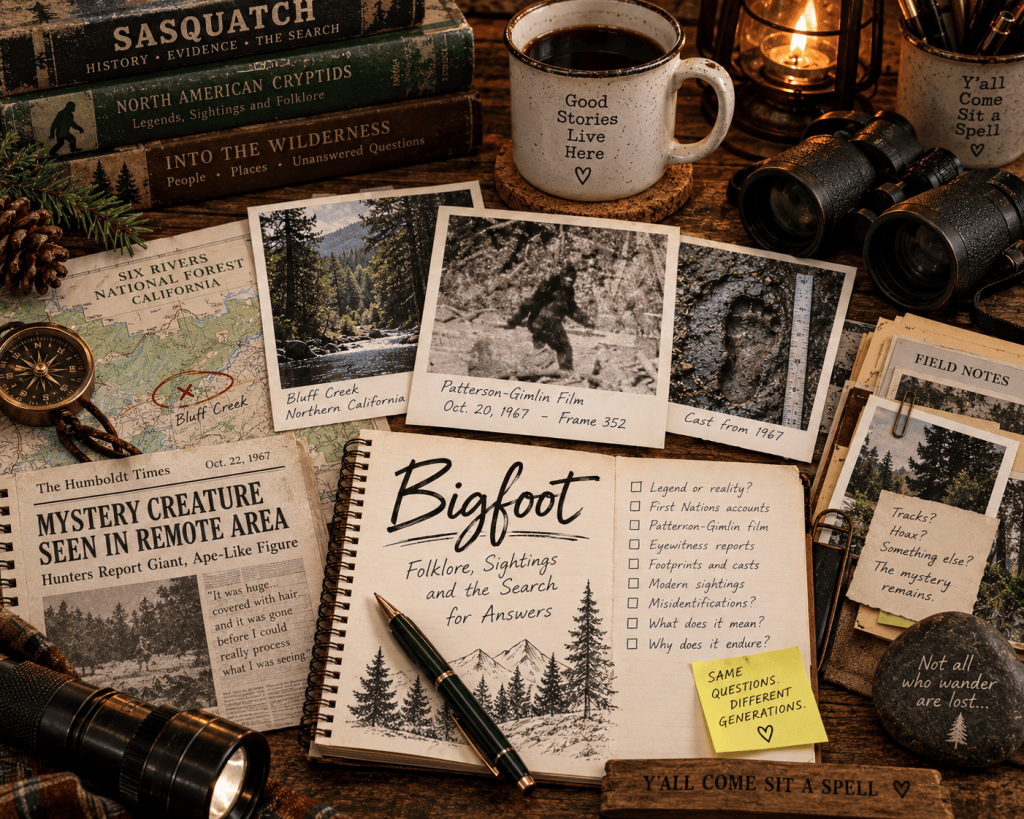
October has arrived, which means we could spend the next 31 days talking about pumpkin spice, sweater weather, and changing leaves.
We’re not doing that.
For the next 31 days, we’re going looking for things that may or may not be looking back. Cryptids. Creatures. Sea monsters. Legends. Eyewitness reports. Questionable photographs. Occasionally compelling evidence. And at least one pair of what appear to be haunted pants.
We’re going to take the stories seriously enough to research them, but not so seriously that we stop having fun.
Come on up, grab a cup. Let’s get weird.
And there is only one place to begin.
Bigfoot.
The Creature
Bigfoot, or Sasquatch, is generally described as a large, powerfully built, hair-covered biped with an apelike or humanlike form. Reported heights commonly reach seven or eight feet, although, as with most creatures nobody has successfully measured while it was standing still, estimates vary considerably.
Its traditional modern range is the forested Pacific Northwest, particularly Northern California, Oregon, Washington, and British Columbia, although reported sightings now come from across North America.
The name Sasquatch is derived from Sasq’ets, a Halq’emeylem word associated with the Sts’ailes people of British Columbia. Indigenous traditions involving wild, hairy, or humanlike beings long predate the creature that twentieth-century popular culture would come to call Bigfoot.
Those traditions are not all interchangeable, and they shouldn’t be treated as if every Indigenous story about a wild being was simply an early Bigfoot sighting.
The modern American Bigfoot story is considerably younger.
The Modern Record
Bigfoot stomped firmly into American popular culture in 1958.
Workers around Bluff Creek in Northern California reported finding enormous footprints near a logging operation. The Humboldt Times covered the tracks, including the name workers had given whatever made them: “Big Foot.”
The story took off.
There had been earlier settler accounts of wild men and large hairy creatures in the Pacific Northwest, including a widely reported 1924 incident near Mount St. Helens. But after Bluff Creek, Bigfoot became something recognizable: enormous footprints, an upright hairy creature, remote forests, and witnesses who were absolutely certain there had been something out there.
Then came 1967.
Patty Walks Across the Screen
On October 20, 1967, Roger Patterson and Bob Gimlin were near Bluff Creek when Patterson filmed a large, hair-covered figure walking away from them across a creek bed.
The footage lasts only seconds.
Nearly sixty years later, those few seconds remain the most famous Bigfoot footage ever recorded.
The figure, commonly nicknamed Patty, walks across the clearing, turns her upper body toward the camera, and continues into the trees.
Believers have spent decades examining her gait, proportions, apparent musculature, and the movement visible beneath the hair. Skeptics have spent just as long arguing that Patty is exactly what she looks like if Bigfoot doesn’t exist: a person wearing a costume.
For almost six decades, nobody managed to end the argument.
Then 2026 happened.
Well. This Is Awkward.
The documentary Capturing Bigfoot, released in 2026, presented newly surfaced footage said to have been filmed in 1966, a year before the Patterson-Gimlin encounter.
The short film reportedly shows what appears to be a rehearsal involving a thinner Bigfoot-like figure walking through wooded terrain.
The documentary also includes statements from members of Roger Patterson’s family who say the famous film was staged.
If the newly surfaced footage is what the filmmakers say it is, that’s a serious problem for Patty.
You don’t generally rehearse an unexpected encounter with an undiscovered primate a year before unexpectedly encountering the undiscovered primate.
Skeptics have understandably treated the documentary as devastating evidence that the Patterson-Gimlin film was a hoax.
Bigfoot researchers have pushed back. Questions have been raised about the dating and interpretation of the rehearsal footage, whether the figure shown is actually the same costume or creature seen in 1967, and whether the new material proves as much as its proponents claim.
Bob Gimlin, now the surviving participant in the original encounter, has continued to maintain that what he and Patterson saw was real.
So Patty has not quietly left the building.
But her chair is wobblier than it was.
What Evidence Do We Actually Have?
After generations of searching, the Bigfoot evidence file is enormous.
It contains eyewitness reports. Footprint casts. Photographs. Videos. Audio recordings. Hair samples. Tree structures. Alleged handprints. Strange smells. Nighttime howls. Thermal images. And enough blurry photographs to make one wonder whether Bigfoot emits some previously unknown field that disables autofocus.
What it does not contain is a verified body, skeleton, tooth, bone, tissue sample, or DNA sequence establishing the existence of an unknown North American great ape.
Some footprint evidence has intrigued researchers. Some alleged tracks have shown anatomical details that proponents argue would be difficult for casual hoaxers to reproduce.
Other famous tracks were absolutely hoaxed.
Some witnesses are undoubtedly sincere.
Sincerity, unfortunately, is not the same thing as identification.
Bears can stand and walk briefly on two legs. Distance distorts size. Darkness is terrible for identification. Human memory is imperfect. Expectations matter. And once people know Bigfoot is supposed to live in a particular forest, every strange sound, enormous shadow, and unidentified footprint arrives with a ready-made suspect.
And then there are people who simply lie.
Bigfoot has attracted rather a lot of those too.
So Is Bigfoot Real?
There is currently no scientifically verified evidence establishing that an unknown giant bipedal primate lives in North America. Most scientists regard Bigfoot as folklore produced through some combination of misidentification, hoaxes, cultural tradition, and human beings’ longstanding fascination with wild creatures that look almost, but not quite, like us.
And yet.
People keep seeing him.
Hunters who know what bears look like say they’ve seen something else.
People who have nothing obvious to gain from telling the story describe encounters that frightened or unsettled them for decades.
Families pass stories down.
Communities incorporate Bigfoot into their identity.
People keep walking into forests carrying cameras, plaster for footprints, thermal equipment, audio recorders, and a stubborn conviction that somewhere beyond the next tree line is an animal science hasn’t catalogued yet.
Maybe they’re wrong.
Statistically and scientifically, that’s where the evidence currently points.
But I understand why they keep looking.
The Grove Take
I think Bigfoot occupies a strange little patch of territory between zoology and hope.
We have mapped the planet. Satellites photograph it. Trail cameras watch our forests. Millions of us carry excellent cameras in our pockets every waking hour.
The world is supposed to be known now.
And maybe Bigfoot represents the stubborn little part of us that doesn’t want it to be.
Maybe we want one forest to still contain something we haven’t named.
One enormous footprint that doesn’t belong to anything in the field guide.
One place on the map where the correct scientific answer remains:
We don’t know.
Do I think an undiscovered breeding population of eight-foot-tall primates is wandering through the Pacific Northwest without leaving behind a body, bone, tooth, or verified DNA?
That’s a hard sell.
Do I want some quiet bastard to have spent the last century watching us stomp around the woods looking for him while staying just out of sight?
Very much.
Porch Ruling
Bigfoot can come up.
He seems shy, generally avoids people, and after everything we’ve done to his reputation, I figure we owe him a cup of something.
He’ll have to sit on the steps, though.
I don’t think the porch furniture is rated for eight feet and 700 pounds.
And if Patty turns out to have been a guy in a suit?
He can come too.
At this point, I have questions.


Leave a comment