I have a system for packing. I tell myself my luggage weighs forty pounds, which leaves ten pounds available for whatever glass, stones, or other treasures decide to come home with me.
The shoes are already accounted for.
People might suggest packing fewer pairs to make room. Those people do not understand the system. Shoes never get sacrificed.
I may have a shoe thing.
I collect them, though I can get rid of a pair when the time is right. Some shoes reach that point. Others have apparently signed a lifetime agreement. I have ruby-red Mary Janes with little heels, well-traveled Birks, and cowboy boots I’ve owned since I was about thirteen. We’ll get to the boots.
My mom and I fought over shoes when I was young. There were pairs I wanted and reasons I couldn’t have them, including the entirely plausible argument that I would outgrow them. I remember Candies in particular. When they came back in style, I rejoiced and went out and bought a pair.
I’m sure my mother thought the matter had been settled years earlier. I had merely been waiting for the shoes to reenter negotiations.
The cowboy boots came from an outlet store where the shoes were cheap. I wanted more than one pair, but Mom said I could have one because I’d outgrow them.
I can still wear them.
I do not bring this up every time I put them on. That would be childish. I only think it very loudly.
My feet have also saved me money in adulthood. My brother and I once went shopping for black leather sneakers we needed for work. I can sometimes buy tennis shoes in the kids’ department because I wear a boys’ size five. My brother found it hilarious that his older sister was shopping there and walked off laughing.
He laughed all the way to the cash register.
I paid $75. He paid $135.
I laughed all the way to the car.
These days I want stylish comfort, and I’ll pay for it when the shoe earns its keep. Hey Dudes, Vionics, and my well-traveled Birks have all had their turns. I want to be able to spend the day on my feet without spending the evening asking them for forgiveness.
But comfort doesn’t have to be pricey. Some of my favorite shoes are $20 slip-on tennies. I order three pairs at a time: a neutral, a dark, and a fun. They last about two years, and then I order three more.
That’s practical. It’s also still a shoe collection, just with a replacement schedule.
I know I don’t need every pair for every trip. I choose what suits where I’m going. Then I leave room for the treasures I expect to find. If a piece of glass comes home with me, wonderful. It gets packed around the things I brought to get there.
The shoes are part of that. The comfortable ones let me keep wandering. The fun ones make me happy. The old ones remind me of who I was when I first wanted them.
And the cowboy boots?
After all these years, they still fit. Mom was right about a great many things, but she did not win that particular argument.
What’s the best way to meet new people while traveling?
Good morning from the Grove, where the coffee is hot and the birds are starting to wake in the woods. October is here, bringing the beauty and flavor of autumn, and we’re grateful for it. For me, it can start with a smile. A smile is a small way of saying, “I’m open to a conversation.” From there, curiosity can carry things along. Ask someone about the place you’re visiting. Be curious about what they’ve seen, where they’re from, or what brought them there. You don’t need a clever opening line. Sometimes a genuine question is plenty. It also helps to let a new connection be whatever it becomes. You don’t have to meet someone with the expectation that they’ll become a lifelong friend. Maybe you share a conversation over a meal or spend an afternoon exploring together. Maybe you find a travel companion you’ll plan future trips with. Maybe you keep up with each other on social media. Maybe you come home with a wonderful memory and a story to tell. I’ve made friends through traveling whom I still travel with. I’ve met people I keep up with online, and others who live on in my memories and stories. Each connection has its own shape, and each has added something to my travels. So my advice is simple: smile, stay curious, and be open to the person in front of you. You don’t have to know where the conversation will lead. You only have to be willing to begin.
Yesterday we stretched our definition of cryptid to accommodate a fictional swamp creature with a propeller for a tail.
Today we’re going to stretch it again.
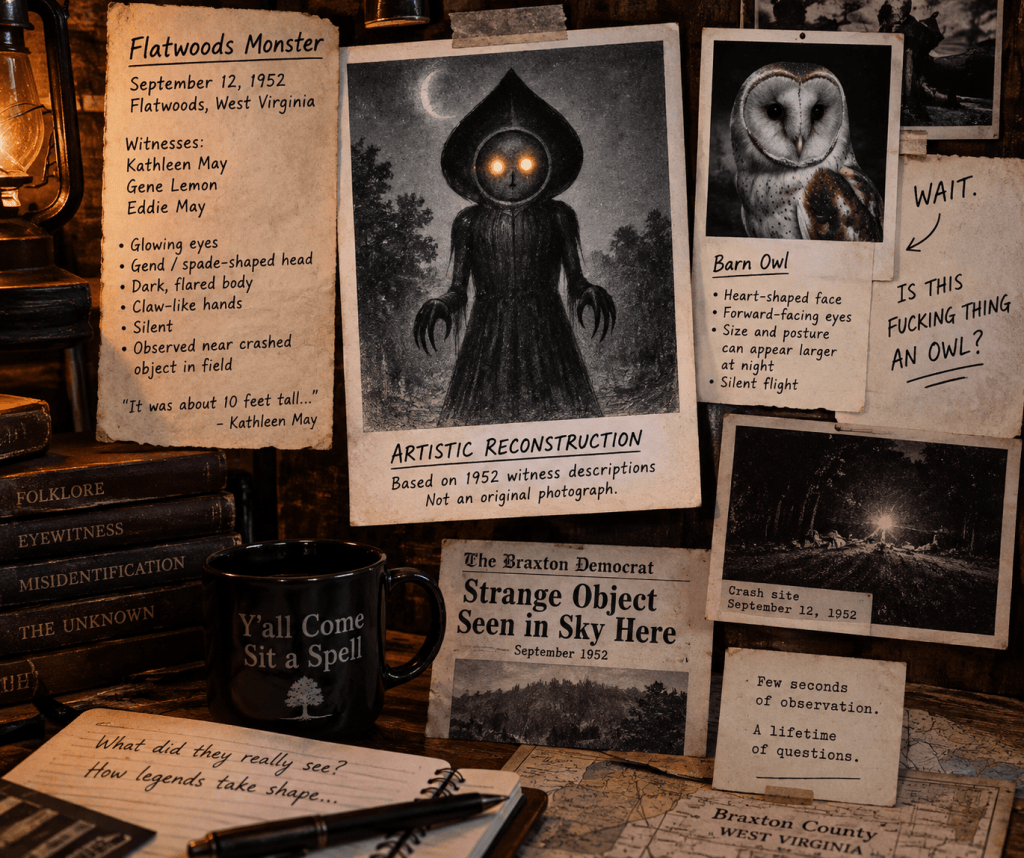
Because the Flatwoods Monster may be a cryptid.
Or an alien.
Or an owl.
Or several completely ordinary things that happened at exactly the right time to scare the living hell out of seven people on a West Virginia hillside.
Welcome to Flatwoods.
The Encounter
On the evening of September 12, 1952, several boys were outside in Flatwoods, West Virginia, when they saw a bright object streak across the sky.
It appeared to come down somewhere beyond a nearby hill on the property of farmer G. Bailey Fisher.
So they did what children have apparently always done when confronted with a potentially dangerous unidentified object.
They went to investigate.
Fortunately, they brought adults.
The group eventually included Kathleen May, her sons Edward and Fred, several other local boys, 17-year-old West Virginia National Guardsman Eugene “Gene” Lemon, and a dog.
The dog will shortly demonstrate better judgment than everyone else involved.
As the group approached the top of the hill, they saw a pulsing red light.
Lemon’s dog ran ahead.
Then the dog came back.
Frightened.
This would have been an excellent time for everyone to acknowledge that the dog had conducted the preliminary investigation and returned a negative recommendation.
They continued.
And Then Gene Lemon Turned on His Flashlight
Near a tree, the group noticed what appeared to be two bright eyes.
Lemon aimed his flashlight toward them.
And everybody got a much better look at something they immediately wished they had not seen.
Descriptions varied, but the creature they reported was enormous, sometimes estimated at ten feet tall.
It had a round, reddish face.
Bright or glowing eyes.
A large pointed shape surrounding its head, often described as resembling the ace of spades.
Below that was a dark body that witnesses described as robe-like, skirt-like, or metallic.
The figure appeared to glide rather than walk.
And then it moved toward them.
The investigation concluded.
Rapidly.
They Were Terrified
This part matters.
Whatever those people saw, the people who interviewed them shortly afterward generally agreed on one thing:
They were frightened.
Not mildly startled.
Terrified.
Local newspaper publisher A. Lee Stewart interviewed the witnesses soon after the encounter and went to the site himself.
The story spread quickly from local newspapers to national media.
One of the strangest-looking creatures in American folklore had acquired its portrait.
But that portrait may also have helped transform a few seconds of terrified observation into something much more definite than the witnesses actually had time to see.
There Was Something in the Sky
This is one of the more interesting parts of the Flatwoods case.
The boys didn’t simply invent the bright object.
A bright meteor or fireball was reported over a wide area that evening.
So something really did streak across the sky.
The question is whether it landed on that West Virginia hillside.
There is no verified evidence that it did.
A meteor seen near the horizon can appear to descend toward the ground even when it is actually traveling far beyond the observer.
The pulsing red light the group later saw on the hill may also have had a perfectly terrestrial source.
An aircraft navigation beacon was visible in the area.
So now we potentially have:
One real meteor.
One ordinary red beacon.
And one very frightened group of people standing in the dark looking for whatever had just fallen out of the sky.
Which brings us to the owl.
We Need to Talk About the Owl
The leading skeptical explanation for the Flatwoods Monster is a barn owl.
Before you dismiss that as ridiculous, go look at a barn owl at night.
Preferably from a safe distance.
They’re beautiful.
They’re also perfectly capable of looking like something that has arrived to collect a debt your ancestors forgot to pay.
Barn owls have pale, heart-shaped faces.
Their eyes can reflect light.
They perch in trees.
Their bodies can appear elongated when viewed beneath spread or partially spread wings.
Vegetation beneath a perched bird could contribute to the appearance of a larger, robe-like lower body.
And if you’ve just watched something fiery cross the sky, followed it into the dark, encountered an acrid smell or mist, heard your dog panic, spotted glowing eyes, and then pointed a flashlight at a large pale-faced bird above you?
Your brain has not been given ideal laboratory conditions.
A startled owl taking flight could also produce the impression that the creature glided toward the witnesses.
That’s a pretty good explanation.
It is not, however, a proven one.
What Evidence Do We Actually Have?
Eyewitness testimony.
Contemporary newspaper reporting.
The witnesses’ descriptions.
A bright object genuinely reported in the sky that evening.
And not much physical evidence capable of settling the question.
Marks and residue reported around the site have acquired greater significance in later retellings, but they did not provide verifiable evidence of a landed spacecraft or unknown creature.
No body.
No biological sample.
No photograph of the creature.
No piece of a spacecraft.
No verified material of extraterrestrial origin.
And the actual encounter was extremely brief, at dusk or after dark, involving people who were already expecting to find something unusual because they believed they had just watched it fall from the sky.
That’s almost a textbook environment for misperception.
Did Project Blue Book Solve It?
You’ll often read that the United States Air Force investigated the Flatwoods incident through Project Blue Book and officially concluded that the witnesses saw a meteor, an aircraft beacon, and an owl.
That’s tidier than the surviving record appears to support.
The Air Force was certainly investigating UFO reports during this period, and the Flatwoods story became entangled with that history.
But evidence of a formal Project Blue Book field investigation producing the familiar meteor-beacon-owl conclusion is difficult to establish.
That explanation was developed and popularized largely through later skeptical investigation.
And that’s worth distinguishing.
Because a good explanation doesn’t need an imaginary government stamp of approval to be good.
The meteor, beacon, and owl combination explains a remarkable amount of what happened that night.
We simply shouldn’t give it provenance it doesn’t have.
The Grove Take
I think they probably saw an owl.
There.
Seven days into Cryptid October and I’ve sided with the bird.
But here’s why I love Flatwoods anyway.
I don’t think those people were lying.
I think something flew across the sky.
I think those kids genuinely believed it came down behind that hill.
I think Kathleen May did something completely understandable and went to see what had frightened the children.
I think the dog encountered something it didn’t like.
I think Gene Lemon pointed his flashlight into a tree.
And I think a large nocturnal bird suddenly illuminated in the West Virginia darkness may have scared the absolute shit out of everybody.
Then humans did what humans do.
They told the story.
An artist gave the creature shape.
Newspapers carried it around the country.
UFO culture absorbed it.
West Virginia adopted it.
And seventy-four years later, that few seconds on a hillside has become one of the most recognizable monster encounters in America.
Maybe nothing extraordinary was standing underneath that tree.
But something extraordinary definitely happened afterward.
A monster was born.
And unlike whatever was on that hill, we know she survived.
Porch Ruling
Come on up, sweetheart.
Monster, alien, owl, whatever.
There’s a seat.
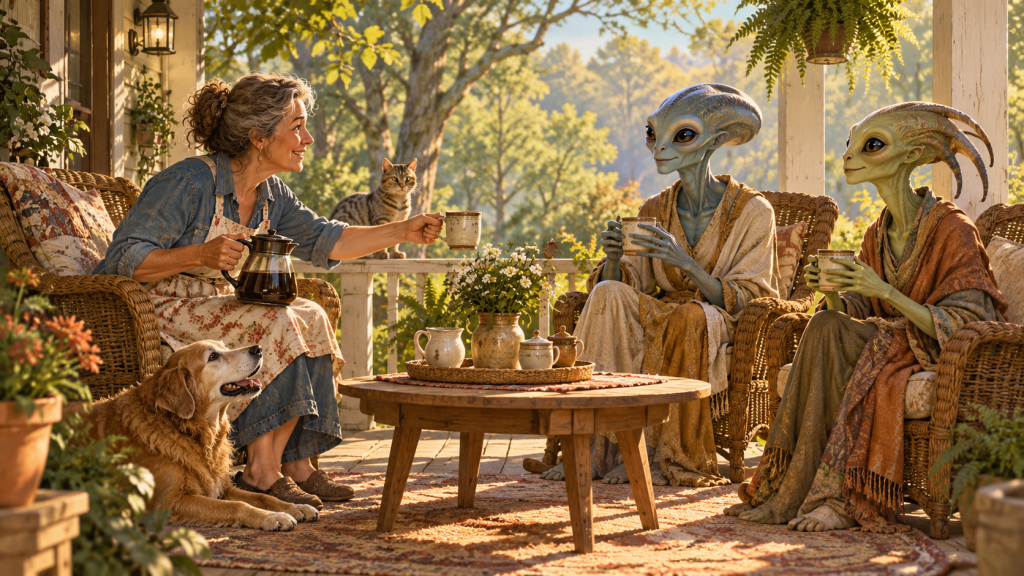
If you’re an extraterrestrial visitor, we’d like to hear about the trip.
If you’re an unidentified Appalachian creature, we have questions.
And if you’re actually a barn owl who accidentally scared seven people badly enough to become a West Virginia icon?
If aliens arrived tomorrow, what’s the first thing you’d ask them?
Good morning from the Grove, where the coffee is hot, and all are welcome.
First, there would be the shock. The staring. The realization that this is not a story or a movie. Then we’d need to make sure everyone was safe and understand whether these visitors meant us harm.
If they weren’t threatening, though, we wouldn’t be inhospitable. We’d put the coffee on and ask, “How do you take yours?”
Maybe they can’t drink coffee. Maybe they have their own idea of a comforting cup. We’d figure that out together. The important part is the invitation: come sit a spell. Tell us about yourselves. Let’s see what we can learn from each other.
The universe could drop company on our doorstep, and once the surprise settled, the Grove would make room at the table. That’s the only way we know to greet a guest.
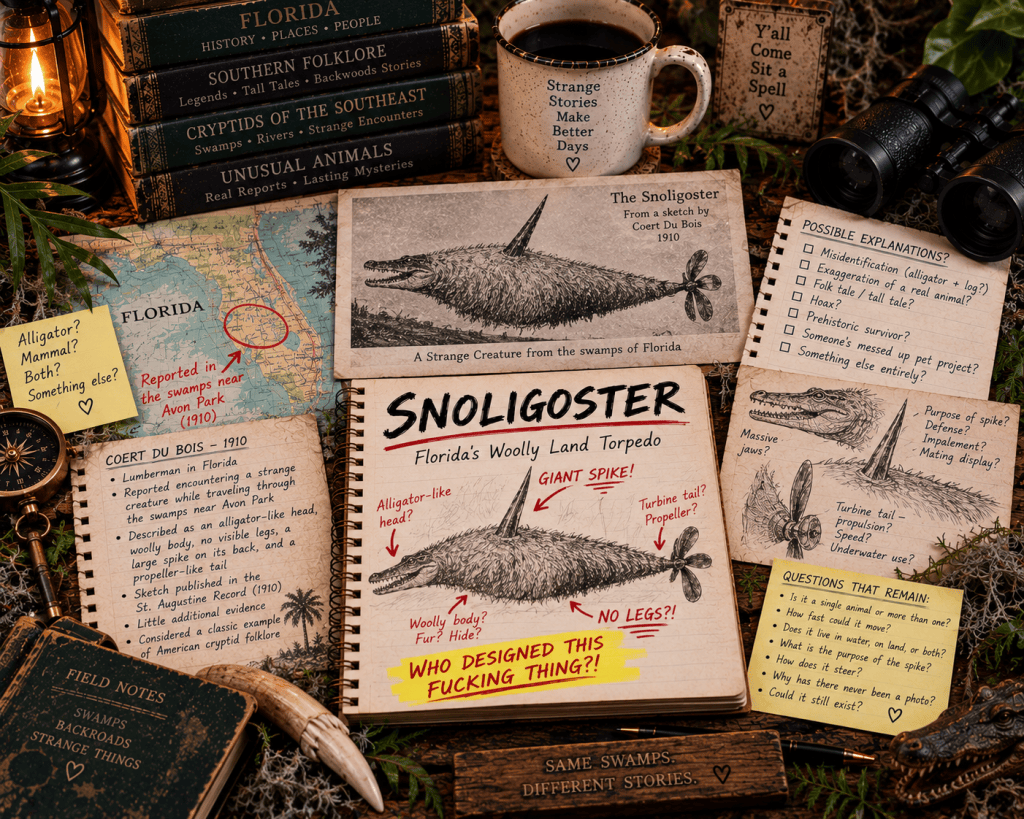
Historical image: The Snoligoster, illustrated by Coert Du Bois for William T. Cox’s Fearsome Creatures of the Lumberwoods (1910). Public domain.
We need to begin today with a confession.
The Snoligoster is not, strictly speaking, a cryptid.
I know.
Before anybody writes to inform me of this oversight, save your keystrokes.
He’s a fearsome critter, part of an American tradition of increasingly ridiculous creatures told about in logging camps and wilderness communities.
But I recently learned that American folklore contains a giant furry Florida swamp creature with an alligator face, a spike on his back, and a propeller for a tail, and there was absolutely no scenario in which I was going to know that information and not make it your problem too.
Our definition of cryptid has been temporarily expanded.
Meet the Snoligoster.
The Creature
The Snoligoster was described in William T. Cox’s 1910 book Fearsome Creatures of the Lumberwoods, With a Few Desert and Mountain Beasts.
Cox placed him in the cypress swamps of the South, particularly around Lake Okeechobee, Florida.
And apparently ordinary swamp anatomy was deemed insufficient.
The Snoligoster is enormous.
He resembles a huge crocodile or alligator, except he’s covered in long, glossy fur.
He has no legs.
No fins.
Instead, one enormous spike projects from his back.
Already we have several engineering concerns.
But you’re probably wondering how a giant, legless, furry alligator gets around a Florida swamp.
Don’t worry.
Nature provided.
He Has a Propeller.
At the end of the Snoligoster’s tail are three large bony plates.
They rotate.
According to Cox, these plates function much like the propeller on a steamboat, spinning fast enough to propel the Snoligoster through water and mud like a torpedo.
I need you to understand that this is not a modern embellishment.
The propeller is right there in 1910.
Somebody looked at the basic design of an alligator and thought:
Needs marine propulsion.
And the tail isn’t merely transportation.
The Snoligoster reportedly uses it as a weapon and, eventually, as something resembling a food processor.
Because apparently the spike wasn’t enough.
What Exactly Is a Fearsome Critter?
This is where the Snoligoster differs from most of the creatures we’ve met so far.
Nobody was conducting a serious zoological search for this thing.
Fearsome critters belonged to the tall-tale culture associated particularly with lumber camps and other wilderness work.
The stories featured impossible animals with equally impossible adaptations.
Creatures might explain strange noises in the woods, disappearing supplies, dangerous terrain, accidents, or whatever other mystery required an animal considerably more entertaining than the actual explanation.
They were also an excellent way to mess with the new guy.
Someone unfamiliar with the woods could be told, with an entirely straight face, about the terrifying creature lurking just beyond camp.
The details could become increasingly absurd.
And if the newcomer continued believing you?
Well.
Now everybody had entertainment for the evening.
The Snoligoster belongs to that world.
Which means our usual question, “What evidence do we actually have?”, becomes rather easy today.
None.
He’s made up.
There.
Cryptid journalism accomplished.
Unfortunately, that isn’t the end of the story.
We Need to Talk About the Original Story
Cox’s 1910 account contains something considerably less amusing than a propeller-tailed swamp monster.
It is explicitly racist.
The story uses racist language for Black people and describes the Snoligoster as preying upon them. Cox relates a supposed account from a Florida man named Inman F. Eldredge in which a Black man is found dead on the creature’s spike.
The story then treats the killing as beneficial because the victim is characterized as a criminal.
I’m not going to reproduce the language here.
You don’t need it to understand what the story says.
And I’m also not going to pretend that part isn’t there so we can get back to laughing about the propeller.
Because folklore doesn’t arrive from some culturally neutral place.
People make stories.
And people bring themselves with them.
Their humor.
Their fears.
Their prejudices.
Their ideas about who matters and who doesn’t.
Sometimes a hundred-year-old joke remains funny.
Sometimes another part of the same joke tells you something ugly about the world in which it was told.
Both can be true.
We’re human.
We’re extremely good at holding contradictory things at the same time.
So Why Keep the Snoligoster?
Because the ugly part doesn’t belong exclusively to the Snoligoster.
It belongs to the history surrounding him.
Erasing the creature doesn’t erase that history.
And stripping the uncomfortable part out so we can present him as nothing more than a charming bit of American folklore doesn’t tell the truth either.
So we keep the whole story.
We acknowledge what it was.
And then we get to decide what we carry forward.
I choose the absurdity.
A furry alligator-shaped swamp torpedo powered by a biological steamboat propeller is objectively magnificent nonsense.
We don’t need the racism to make him interesting.
Frankly, he has a propeller for a tail.
The man was never hurting for material.
But Why “Snoligoster”?
Excellent question.
I wish I had an excellent answer.
Cox calls the creature the Snoligoster and even supplies the wonderfully scientific-sounding name Dorsohastatus caudirotula.
He doesn’t explain where “Snoligoster” came from.
There is, however, an older American word that looks suspiciously familiar.
Snollygoster.
The word was in use during the nineteenth century and eventually came to describe a clever, unscrupulous person, particularly a politician.
It is very tempting to assume that Snoligoster grew from Snollygoster.
Maybe it did.
But tempting isn’t evidence.
I couldn’t find documentation establishing that Cox deliberately borrowed the word for his swamp creature.
So we’re going to do something that will happen occasionally during these 31 days.
We’re going to say:
I don’t know.
It’s much better than making something up and waiting for the internet to copy us.
The Grove Take
I love that humans invented fearsome critters.
Of course we did.
Imagine spending weeks in a logging camp before television, phones, streaming services, or an internet capable of supplying you with haunted pants on demand.
Eventually somebody was going to look across the fire at the new guy and say:
“You know about the Snoligoster, right?”
And somebody else knew enough to shut the hell up and let him cook.
Maybe the next person added the spike.
Maybe somebody improved the tail.
Maybe the story got a little bigger every time it was told.
That’s not evidence of an undiscovered animal.
It’s evidence of something we already know exists.
Sometimes irritating, but I have enjoyed stories with love triangles.
The chosen one?
Frequently exhausting, but occasionally wonderful.
Dead parents?
Practically an entry requirement for adventure, but not automatically a problem.
Enemies to lovers? Redemption arcs? Surprise betrayals? Miscommunication? The brilliant detective with terrible social skills? The villain who pauses long enough to explain the entire plan?
I mentally ran through the usual suspects.
None of them quite worked.
Almost every trope I considered had appeared in at least one story I loved. Sometimes the familiar structure was part of why I loved it. I knew what kind of story I had entered, understood its general rules, and happily settled in for the ride.
So why did the prompt irritate me?
Why could I not select one perfectly respectable storytelling device, complain about it for a few paragraphs, and move on with my life?
Then I looked at the list again.
Love triangle.
Dead parent.
Chosen one.
Miscommunication.
Redemption arc.
Enemies to lovers.
Surprise betrayal.
And my brain finally went:
WAIT. THAT. THAT’S THE FUCKING PROBLEM.
It was not which trope annoyed me most.
It was being able to see it.
The most annoying trope is the one that reminds me I am watching a trope instead of experiencing a story.
The Bones Are Not the Problem
Stories have always shared bones.
Someone leaves home.
Someone falls in love.
Someone wants power.
Someone loses something important and tries to recover it.
Someone encounters a monster, survives a journey, solves a mystery, seeks revenge, earns forgiveness, or discovers that the thing they wanted was not the thing they needed.
We have been telling variations of these stories for as long as we have been telling stories.
There are only so many basic human desires and conflicts available. We want love, safety, belonging, freedom, recognition, meaning, and occasionally the satisfaction of watching an arrogant bastard receive exactly what he has earned.
Reusing those desires is not laziness.
Tropes aren’t lazy. Lazy use of tropes is lazy.
A brilliant writer can give us a story whose bones we have encountered fifty times before, and we will not care because we are completely inside this version of it.
We care about these people.
We believe their choices.
We understand what they stand to lose.
We may know exactly where the story is headed and still desperately want to go there.
Predictable Is Not Necessarily Bad
Predictability receives more criticism than it deserves.
Romance readers generally know the central couple will end up together. That promise is part of the genre. The question is not whether love will triumph.
The question is how.
What will these two people misunderstand about each other? What will they have to risk? What must they learn about themselves before they can build something together?
Mystery readers expect the mystery to be resolved. We are not disappointed when the detective eventually identifies the killer. We are reading to gather clues, test theories, suspect everyone, and discover whether the explanation earns the path that led us there.
In many stories, knowing roughly where we are headed is part of the pleasure.
The destination is not the story.
A road trip does not become pointless because we know which city appears at the end of the highway. The journey is everything that happens between departure and arrival. It is the detour, the argument, the terrible gas-station coffee, the song everyone sings badly, and the moment somebody finally says the thing they have been avoiding for three hundred miles.
A familiar destination can still contain an extraordinary journey.
The problem begins when the journey stops feeling true.
When the Characters Notice the Outline
There is a moment when a story can lose me completely.
A character who has been intelligent for ninety pages suddenly becomes incapable of basic reasoning.
Two people who have communicated honestly through every previous conflict refuse to have a thirty-second conversation because the plot needs a misunderstanding.
Someone hears half a sentence through a doorway, assumes the worst possible meaning, and runs away before hearing the rest.
A competent adult walks alone into a dark basement after finding the front door open, the lights disabled, and three blood-covered warnings painted across the wall.
A close friend becomes irrationally hostile because the protagonist needs opposition before the final act.
The behavior does not emerge from who the character is.
It emerges from where the outline needs the character to stand.
That is when I can see the index cards on the writer’s wall.
Character refuses to explain.
Move card.
Couple separates.
Move card.
Threat arrives.
Move card.
Truth revealed after forty avoidable minutes.
The people disappear. The machinery remains.
I am no longer wondering what the character will do. I am watching the writer drag them toward the next required scene while the character’s previously established intelligence claws desperately at the carpet.
Once I see that happening, it is difficult to unsee.
Earn It
A trope works when the story earns it.
If two characters are going to become enemies, show me the fracture. Let their values collide. Give them something real to misunderstand or something painful they cannot forgive.
If someone is going to betray a friend, plant the fear, ambition, resentment, or desperation that makes the betrayal possible.
If the lovers must separate, make the obstacle larger than one honest conversation and a charged phone.
If the hero is going into the murder basement, give me a reason that makes remaining upstairs impossible.
The audience will accept almost anything if the emotional logic holds.
Dragons? Fine.
Time travel? Absolutely.
A centuries-old sea creature applying for a seat on the porch? We have procedures.
But do not ask me to believe that a woman who has spent twelve chapters solving complex political problems cannot recognize an obvious lie because the surprise betrayal is not scheduled to be revealed until Chapter Twenty.
Fantasy still requires truth.
The world can be impossible. The people living inside it must remain emotionally believable.
Familiar Does Not Mean Empty
Some tropes endure because they work.
Enemies to lovers gives conflict somewhere to transform.
The reluctant hero lets us watch courage develop rather than arrive fully formed.
The found family speaks to anyone who has ever needed to build the belonging they were not given.
The redemption arc asks whether people can become more than the worst thing they have done.
The haunted house gives grief somewhere physical to live.
We return to these structures because they hold questions we have not finished asking.
The familiar shape is not the failure.
The failure is treating the shape as though it can do the writer’s work by itself.
Calling two characters enemies does not create chemistry.
Killing a parent does not automatically create depth.
Giving someone a prophecy does not make them interesting.
Hiding crucial information does not create suspense if everyone involved must behave like an idiot to keep it hidden.
A trope is a tool.
It is not a substitute for character, consequence, or emotional truth.
The Actual Answer
So, after several days of staring at a prompt that requested one annoying trope, I finally found my answer.
My least-favorite trope is not the love triangle.
It is not the chosen one.
It is not the dead parent, the surprise villain, the fake relationship, the redemptive sacrifice, or the misunderstanding that could have been resolved before breakfast.
My least-favorite trope is whichever one becomes more visible than the story carrying it.
It is the moment I stop seeing people and start seeing index cards.
It is the moment a character stops making choices and begins obeying instructions.
It is the moment the story reminds me that someone has placed the furniture this way because the next scene requires me to trip over it.
Good morning from the Grove, where the coffee is good and Tuesday has started kindly. This morning’s prompt asks about the most underrated life skill. My answer is appreciating contentment. So many of us are rushing toward the best, the highest, the newest, and the most. We compare our homes, our cars, our phones, our vacations, even the little details of everyday life. The “keeping up with the Joneses” mentality keeps moving the finish line. Just when we think we have enough, someone else has something newer or shinier, and we start wondering if we need that too. Do you really need the new iPhone? Maybe your old one is broken, or the new features would make a real difference in your life. But if the phone in your hand still does what you need, maybe it is fine right where it is. It can be hard to hear that over all the messages telling us to upgrade, replace, and buy more. There is a strange split in the way we talk about contentment. We are encouraged to love ourselves as we are, to believe that we are enough. Then we turn toward the things we own and hear that they are already outdated. A perfectly good phone becomes inadequate because a newer model exists. A home, a wardrobe, or a life that once felt comfortable can suddenly seem like something that needs improving. Consumerism depends on that feeling. If we are always convinced that the next thing will make us happier, we keep reaching for it. And while we are reaching, it is easy to overlook what is already good. Appreciating contentment is the ability to pause and recognize that something is enough for now. The coffee is good. The old phone works. The day has started gently. We can enjoy those things without turning them into a list of upgrades. Contentment can live alongside plans and dreams. We can want a different job, a bigger garden, or a new adventure and still appreciate the life we have today. It asks us to notice the difference between wanting something because it would truly serve us and wanting it because comparison has made what we have feel smaller. Maybe we could all use that pause before the next purchase or the next comparison. Does this meet my needs? Do I enjoy it? Is there something here I have stopped noticing because I am busy looking for more? Sometimes the most underrated life skill is knowing when to let a good thing be good. We do not have to climb every ladder someone puts in front of us. We can sit on the porch, take a breath, and appreciate what is already here. May we find a little contentment in the ordinary things today, and remember that sometimes it is fine exactly where it is.
Good morning from the Grove, where the coffee is good and Tuesday has started kindly. This morning’s prompt asks about the most underrated life skill. My answer is appreciating contentment. So many of us are rushing toward the best, the highest, the newest, and the most. We compare our homes, our cars, our phones, our vacations, even the little details of everyday life. The “keeping up with the Joneses” mentality keeps moving the finish line. Just when we think we have enough, someone else has something newer or shinier, and we start wondering if we need that too. Do you really need the new iPhone? Maybe your old one is broken, or the new features would make a real difference in your life. But if the phone in your hand still does what you need, maybe it is fine right where it is. It can be hard to hear that over all the messages telling us to upgrade, replace, and buy more. There is a strange split in the way we talk about contentment. We are encouraged to love ourselves as we are, to believe that we are enough. Then we turn toward the things we own and hear that they are already outdated. A perfectly good phone becomes inadequate because a newer model exists. A home, a wardrobe, or a life that once felt comfortable can suddenly seem like something that needs improving. Consumerism depends on that feeling. If we are always convinced that the next thing will make us happier, we keep reaching for it. And while we are reaching, it is easy to overlook what is already good. Appreciating contentment is the ability to pause and recognize that something is enough for now. The coffee is good. The old phone works. The day has started gently. We can enjoy those things without turning them into a list of upgrades. Contentment can live alongside plans and dreams. We can want a different job, a bigger garden, or a new adventure and still appreciate the life we have today. It asks us to notice the difference between wanting something because it would truly serve us and wanting it because comparison has made what we have feel smaller. Maybe we could all use that pause before the next purchase or the next comparison. Does this meet my needs? Do I enjoy it? Is there something here I have stopped noticing because I am busy looking for more? Sometimes the most underrated life skill is knowing when to let a good thing be good. We do not have to climb every ladder someone puts in front of us. We can sit on the porch, take a breath, and appreciate what is already here. May we find a little contentment in the ordinary things today, and remember that sometimes it is fine exactly where it is.
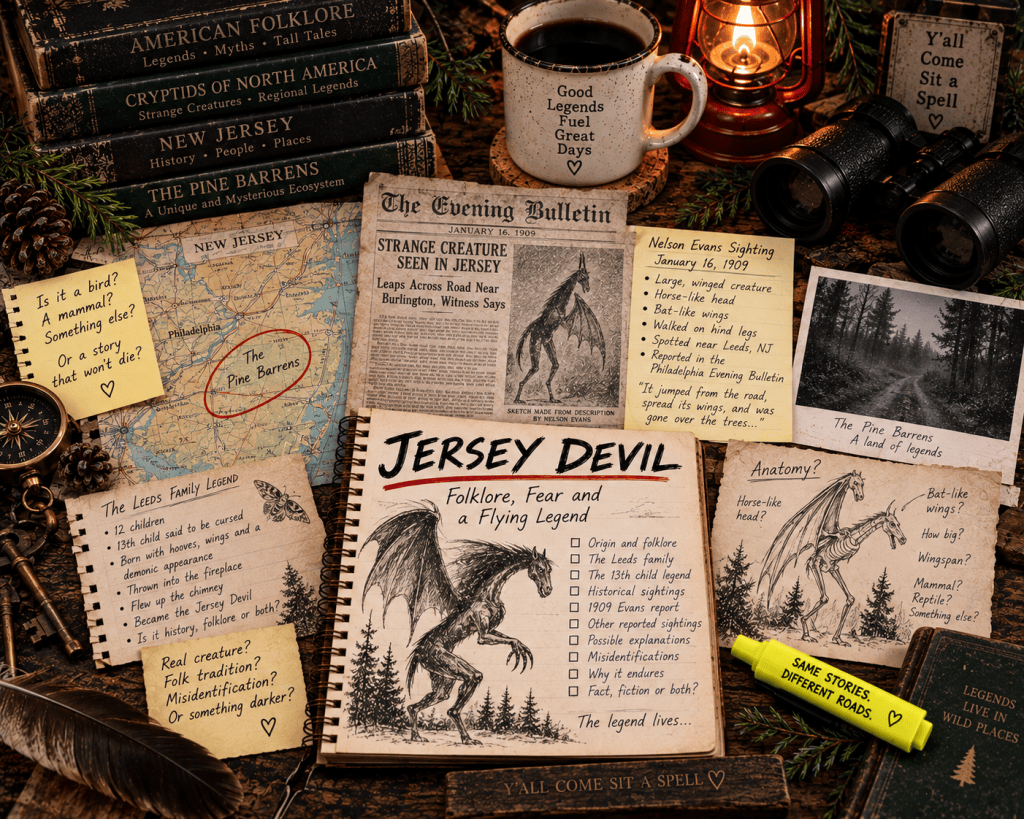
Historical illustration of the Jersey Devil, Philadelphia Evening Bulletin, January 1909. Public domain.
For the past four days, we’ve met giant hairy bipeds, upright dogs, haunted pants, and a possibly prehistoric forest guardian with questionable personal hygiene.
Today we’re going to New Jersey.
That sentence may be frightening enough on its own.
But we’re specifically heading into the Pine Barrens, more than a million acres of forest, wetlands, sandy roads, abandoned settlements, and exactly the sort of landscape where you would expect somebody to eventually say:
There’s something in those woods.
And people have.
For centuries.
Meet the Jersey Devil.
The Creature
Descriptions of the Jersey Devil vary wildly, which will become something of a theme today.
But the version most people recognize is a creature that appears to have been assembled from whatever parts were left in the bin.
Horse-like head.
Long neck.
Bat-like wings.
Cloven hooves.
Claws.
Long or forked tail.
Sometimes short front legs.
Sometimes none.
Often glowing red eyes.
It walks on two legs.
Except when it walks on four.
It flies.
It screams.
And depending on which witness you ask, it may resemble a horse, kangaroo, dog, goat, crane, dragon, enormous bat, or something assembled after somebody lost the instructions.
It has reportedly haunted southern New Jersey’s Pine Barrens for hundreds of years.
At least that’s the legend.
The history is considerably messier.
And, frankly, much more fun.
Mother Leeds Has Had Enough
The traditional origin story takes us to 1735.
A woman known as Mother Leeds was supposedly pregnant with her thirteenth child.
Having apparently reached the reasonable limit of her enthusiasm for childbirth, she cursed the pregnancy and declared that the child might as well be the Devil.
This was, according to legend, an unfortunate choice of words.
The baby was born human, or nearly so, but quickly transformed into something monstrous.
Horse head.
Hooves.
Claws.
Bat wings.
Tail.
The newborn creature attacked those around it, flew up the chimney, and disappeared into the Pine Barrens.
And thus the Jersey Devil was born.
It’s a fantastic story.
We have a small problem.
We can’t establish that it happened.
There Really Was a Leeds Family
This is where folklore and documented history begin tangling themselves together.
A prominent Leeds family really did live in southern New Jersey.
Daniel Leeds settled in colonial New Jersey in the seventeenth century and became an almanac publisher, surveyor, landowner, and eventually a man who managed to irritate a substantial portion of his religious community.
Leeds was a Quaker.
Until things went badly.
His almanacs included astrology and other material some fellow Quakers considered inappropriate or blasphemous. The disagreement escalated into an extremely public religious and political feud.
Daniel Leeds eventually broke with the Quakers, converted to Anglicanism, supported the British Crown, and published writings attacking his former religious community.
His opponents responded in kind.
And somewhere in all that seventeenth-century subtweeting with pamphlets, the Leeds name became associated with the Devil.
Not metaphorically subtle, these people.
And Then Benjamin Franklin Got Involved
Because apparently this story wasn’t already good enough.
Daniel’s son Titan Leeds continued publishing the family almanac.
Unfortunately for Titan, another almanac publisher entered the market.
Benjamin Franklin.
Yes.
That Benjamin Franklin.
Franklin’s Poor Richard’s Almanack competed with Titan Leeds’s publication, and Franklin decided that ordinary marketing was for cowards.
He predicted that Titan Leeds would die.
When Leeds objected to reports of his own death, Franklin responded by insisting that Titan Leeds must indeed be dead and that whoever was protesting was an imposter using his name.
Franklin continued the joke for years.
So now we have a family already associated with religious controversy, astrology, political disputes, accusations involving the Devil, and a Founding Father publicly insisting that one of them was dead.
And we’re still not finished.
The Leeds family crest featured wyverns.
Winged, dragon-like creatures.
At this point folklore barely had to do any work.
So Where Is Mother Leeds?
That’s harder.
Various attempts have been made to identify the legendary Mother Leeds with actual women in the family.
Deborah Leeds is frequently suggested because records indicate that she and her husband Japhet had twelve children, making another pregnancy fit rather nicely into the thirteen-child legend.
But fitting nicely isn’t documentation.
There is no contemporary record showing Deborah Leeds giving birth to a monster.
Which feels like the sort of thing somebody might have written down.
Historians studying the legend argue that the familiar Mother Leeds birth story developed later from a much messier collection of family history, religious hostility, political insult, local storytelling, and eventually popular entertainment.
In other words:
There probably wasn’t one night in 1735 when the Jersey Devil suddenly entered the world.
People built him.
And then, in 1909, he exploded.
The Week New Jersey Lost Its Mind
In January 1909, strange tracks began appearing in the snow around southern New Jersey.
Hoof-like tracks.
They crossed yards.
Roads.
Fields.
And, according to newspaper reports, even rooftops.
Then came the sightings.
People reported a bizarre winged creature.
Schools reportedly closed or experienced widespread absences.
Workers were frightened.
Posses formed.
People armed themselves.
Dogs sent after the creature supposedly refused to follow its trail.
Newspapers published breathless reports as sightings spread through New Jersey and into Pennsylvania and Delaware.
Witness descriptions were wonderfully inconsistent.
One creature had a crane-like neck and a collie-like head.
Another had monkey-like hands and feet.
Others described wings, hooves, long hair, glowing eyes, or something resembling a kangaroo.
For several days, the region had itself a full-blown monster panic.
And newspapers were delighted.
Then Somebody Caught One
Sort of.
A creature advertised as the Leeds Devil was eventually displayed in Philadelphia.
People could pay to see it.
There was just one problem.
It was reportedly a kangaroo fitted with artificial wings.
Which is objectively magnificent showmanship but very poor cryptozoological evidence.
A former newspaperman and theatrical publicist named Norman Jeffries has long been associated with the hoax and with helping turn the 1909 panic into a publicity opportunity.
That doesn’t necessarily explain every footprint or every reported sighting from that week.
But it does remind us of something we’ve already learned during our first five days together:
Once people expect to see a monster, they start seeing the monster.
What Evidence Do We Actually Have?
A great deal of folklore.
Centuries of stories.
Newspaper reports.
Eyewitness accounts.
Tracks of uncertain origin.
Occasional photographs and videos.
And an impressive number of people who remain absolutely convinced that something unusual lives in the Pine Barrens.
What we don’t have is physical evidence establishing the existence of an unknown winged animal.
No verified body.
No bones.
No tissue.
No DNA.
No specimen.
And the wildly inconsistent anatomy creates its own problems.
A horse-headed, bat-winged, hoofed biped with tiny arms and a forked tail would represent an animal unlike anything currently known to science.
Which doesn’t technically make it impossible.
It does substantially increase the amount of evidence we’re going to require.
A strange footprint in the snow isn’t going to get us there.
What Might People Be Seeing?
Several ordinary animals have been nominated over the years.
Owls.
Large bats.
Deer.
And especially sandhill cranes.
A sandhill crane can stand roughly four feet tall, has an enormous wingspan, long legs, a long neck, and can make calls that sound deeply inappropriate coming from an animal you weren’t expecting to encounter in the dark.
Could a crane explain every Jersey Devil sighting?
No.
Could an unexpectedly large bird seen briefly at night account for some reports of a tall, winged creature?
Absolutely.
Hoaxes explain others.
Folklore probably shapes still more.
And then there’s the Pine Barrens themselves.
Huge.
Forested.
Historically isolated.
Filled with abandoned places and dark roads.
If you wanted to build a monster somewhere, you could do much worse.
The Grove Take
I adore the Jersey Devil.
Not because I think a horse-headed demon baby flew up somebody’s chimney in 1735.
I don’t.
I love him because you can practically watch humans manufacture a monster around him.
A real family has religious disagreements.
Politics gets ugly.
People call each other devils.
An almanac publisher uses astrology.
His family crest has dragons.
Benjamin Franklin decides to troll his competitor for several years.
Stories get told.
Stories get embellished.
Something makes strange tracks in the snow.
Newspapers smell blood.
People start looking.
People start seeing.
Some jackass puts wings on a kangaroo.
And three hundred years later, we’re still talking about the Jersey Devil.
That is spectacularly human.
We don’t simply encounter monsters.
Sometimes we make them.
And every generation adds a little something until nobody can quite remember where history ended and the creature began.
Honestly?
That may be more interesting than finding an actual monster in the woods.
Porch Ruling
The Jersey Devil is absolutely welcome on the Porch.
He’s been blamed for enough shit he probably didn’t do.
Come on up, sweetheart.
We’ll get you a cup.
But the wings stay folded.
The porch isn’t that big, and I don’t need you knocking over the plants.
Also, if you happen to see Benjamin Franklin wandering around out there?
What’s a personal mantra or philosophy you live by?
Good morning from the Grove, where the coffee is hot, the pups have had breakfast, the sun is rising, and the air outside is glorious.
My personal mantra? Words have Power.
That simple idea reaches into so many parts of life. Words can comfort us, encourage us, and help us understand one another. They can also wound, frighten, divide, and persuade. The words we choose matter, so I try to take the time to choose them with care.
Words shape our feelings, and feelings can shape our choices. The way we speak to ourselves matters, too. Mindset isn’t everything, but it can change how we meet a hard day, a new opportunity, or another person. What we send into the world has a way of finding its way back to us, even if it doesn’t always return in the same form or on our preferred schedule.
And this power belongs to more than the words we say. Advertisers understand how a phrase or image can stir up desire or fear. News writers know that the words in a headline can frame a story before we’ve read a single detail. Political ads… don’t get me started. Propaganda and manipulation often depend on getting us to react before we have time to think.
That’s why choosing words carefully also means listening carefully. We have to be critical consumers of what we take in. Who is speaking? What do they want us to feel or believe? What might be hidden behind the smoke and mirrors? A strong emotional reaction can be a reason to pause and look closer.
“Words have Power” reminds me to be thoughtful about what I put into the world and thoughtful about what I allow to shape my view of it. It’s a small mantra with a lot of room inside it.
Speaking of our views of the world, I hope you’ve joined our October Cryptid Study. We’re exploring the myths and mysteries of cryptids, and the stories people have carried home from the woods. I love thinking about what those stories say about the people who tell them, and leaving a little room for the possibility that the world still holds things we can’t explain.
Yesterday we investigated what may be an unidentified long-legged humanoid, an elaborate hoax, a camera artifact, or bug legs.
We ruled Haunted Pants.
Today we’re going considerably deeper into the forest.
Deep into the Amazon, in fact, where stories have circulated for generations about something large, hairy, extraordinarily difficult to kill, and possessed of one characteristic nearly everyone seems to agree upon:
It smells terrible.
Meet the Mapinguari.
The Creature
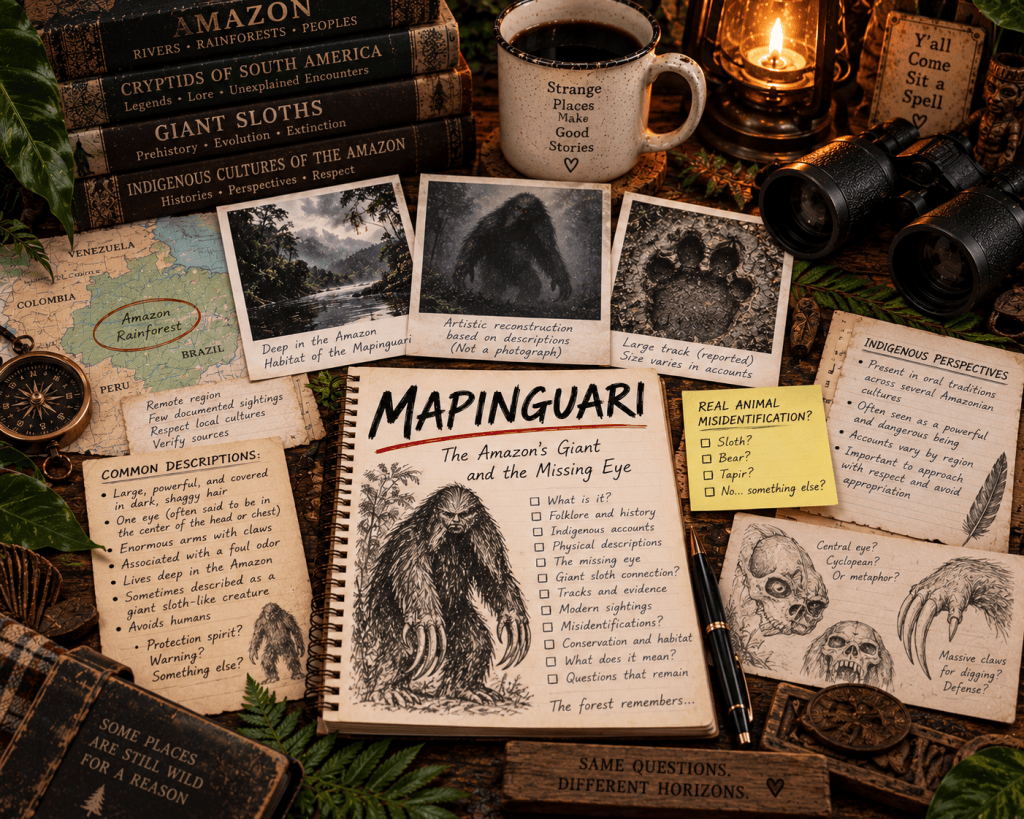
There is no single description of the Mapinguari.
That is important.
Stories come from different communities across a very large region, have been told and retold over generations, and don’t necessarily describe exactly the same being.
But certain characteristics appear repeatedly.
Something large.
Hairy.
Powerful.
Often capable of standing or walking upright.
Long claws.
An extraordinarily foul smell.
Some accounts describe a hide so tough that bullets or arrows cannot penetrate it.
Then things get considerably stranger.
In some traditions the Mapinguari has one eye.
In others, backward-facing feet.
And perhaps most memorably, some versions give it an enormous second mouth in its abdomen.
Which is admittedly difficult to reconcile with any known mammal.
But before we decide we’ve wandered completely out of zoology and into mythology, there’s another version of the Mapinguari we need to meet.
Because some people who say they’ve encountered one describe something considerably more animal-like.
And one scientist thought those descriptions sounded familiar.
The Scientist Who Went Looking
David Oren was an ornithologist and zoologist associated with Brazil’s Museu Paraense Emílio Goeldi.
When he first heard stories of the Mapinguari during his work in the Amazon, he regarded them as folklore.
Then he began hearing firsthand accounts.
Hunters, rubber tappers, miners, and Indigenous people described encounters with large animals that Oren thought sounded remarkably similar to something science knew very well.
Just not something science believed was still alive.
A ground sloth.
In 1993, Oren published a scientific paper proposing that at least some Mapinguari reports might represent either relatively recent encounters with ground sloths or, much more controversially, encounters with a surviving population.
And yes.
Giant ground sloths were absolutely real.
There Really Were Giants in These Woods
South America was once home to multiple species of ground sloth.
Some were enormous.
These weren’t the small, slow-moving tree sloths we know today. Ground sloths lived on the ground, possessed formidable claws, and some species could rise onto their hind limbs.
Some also had small bony structures called osteoderms embedded in their skin.
Which suddenly makes a few pieces of Mapinguari lore interesting.
Large and hairy?
Check.
Long claws?
Check.
Capable of standing upright?
Check.
Hide unusually difficult to penetrate?
Well.
Now we at least have something worth talking about.
Oren thought the similarities were strong enough to investigate.
So he did.
People Said They Had Seen It
Oren traveled through areas where Mapinguari encounters were reported and interviewed people who claimed to have seen the creature.
Some said they had seen one at close range.
Several told him they had killed one.
Accounts described an animal around six feet tall when upright, heavily built, covered in coarse hair, armed with powerful claws, and producing an overwhelming odor.
There were reports of tracks.
Damaged vegetation.
Hair.
Feces.
And stories from people accustomed to spending their lives in the forest who insisted that whatever they encountered was not an animal they recognized.
That’s considerably more interesting than somebody’s cousin seeing something cross the interstate at two in the morning.
But eyewitness testimony still isn’t a specimen.
And eventually, science needs the animal.
What Evidence Do We Actually Have?
This is where our surviving-ground-sloth story runs into trouble.
No verified Mapinguari body has been recovered.
No skeleton.
No bone from a recently living unknown ground sloth.
No photograph clearly establishing such an animal.
No verified tissue.
No DNA.
Oren and others collected material thought potentially to have come from the creature.
At least one fecal sample was eventually identified through DNA analysis.
It belonged to a known animal.
An anteater.
Other physical samples associated with alleged Mapinguari encounters have likewise failed to establish the existence of an unknown species.
And the fossil record presents an enormous problem for the living-ground-sloth hypothesis.
Ground sloths disappeared from mainland South America thousands of years ago.
Keeping a breeding population of very large mammals hidden for all that time without leaving behind a recent bone, carcass, tooth, or verified biological sample would be quite an achievement.
The Amazon is enormous.
It is difficult to explore.
It unquestionably still contains species science hasn’t described.
But an undiscovered frog and an undiscovered six-foot terrestrial mammal present rather different logistical problems.
But What About the Stories?
This is where I want to be particularly careful.
The Mapinguari does not need to turn out to be a surviving prehistoric animal for the stories to matter.
And the different Indigenous traditions involving Mapinguari-like beings should not be treated as nothing more than primitive eyewitness reports waiting for Western science to identify the animal correctly.
Among the Karitiana people of Rondônia, for example, beings associated with what Portuguese speakers call the Mapinguari have their own names, stories, and place within the way people understand and move through the forest.
In many tellings across the Amazon, the Mapinguari also functions as a protector of the forest.
It punishes people who hunt excessively.
It keeps humans from taking more than they should.
It inhabits places where people are supposed to remember that the forest does not belong entirely to them.
Whether there is an animal behind some of the encounters is a different question.
And keeping those questions separate matters.
Could the Stories Remember a Real Animal?
Now this is where I get interested.
We know human beings and giant ground sloths overlapped in South America.
That isn’t cryptozoology.
That’s paleontology.
Could memories of encounters with those animals have survived through oral traditions long after the animals themselves disappeared?
Possibly.
Could characteristics of real animals have become mixed over generations with spiritual beliefs, other forest creatures, warnings, storytelling, and cultural meaning?
Absolutely.
Can we demonstrate that this is what happened with the Mapinguari?
No.
And that’s an important no.
A compelling hypothesis is still a hypothesis.
There is a substantial difference between:
“This story contains characteristics reminiscent of an extinct animal.”
and
“This story proves people preserved an accurate zoological description for thousands of years.”
The first is fascinating.
The second requires evidence we don’t currently have.
The Grove Take
I don’t think there’s a giant ground sloth wandering around the Amazon today.
I’d love to be wrong.
Because unlike Haunted Pants, we don’t have to imagine what a ground sloth would have looked like.
They were here.
Actual enormous mammals with ridiculous claws once walked through South America while humans were walking through South America too.
That alone is extraordinary.
Maybe the Mapinguari carries a little memory of them.
Maybe it doesn’t.
Maybe people encountered known animals under unusual circumstances and stories grew around those encounters.
Maybe several completely different traditions eventually got gathered under one convenient name.
Or maybe something very large is still standing behind a tree somewhere in several million square miles of rainforest thinking:
These people have been looking for me for HOW long?
I don’t think so.
But this is only Day Four.
I’m still allowed to hope occasionally.
Porch Ruling
The Mapinguari is welcome at the Grove.
But we’re going to need some ground rules.
First, no abdominal mouths at the dinner table.
Second, we’re going to respect the forest, so there should be no need for the whole avenging-guardian situation.
And finally, if the smell is even half as bad as reported: